

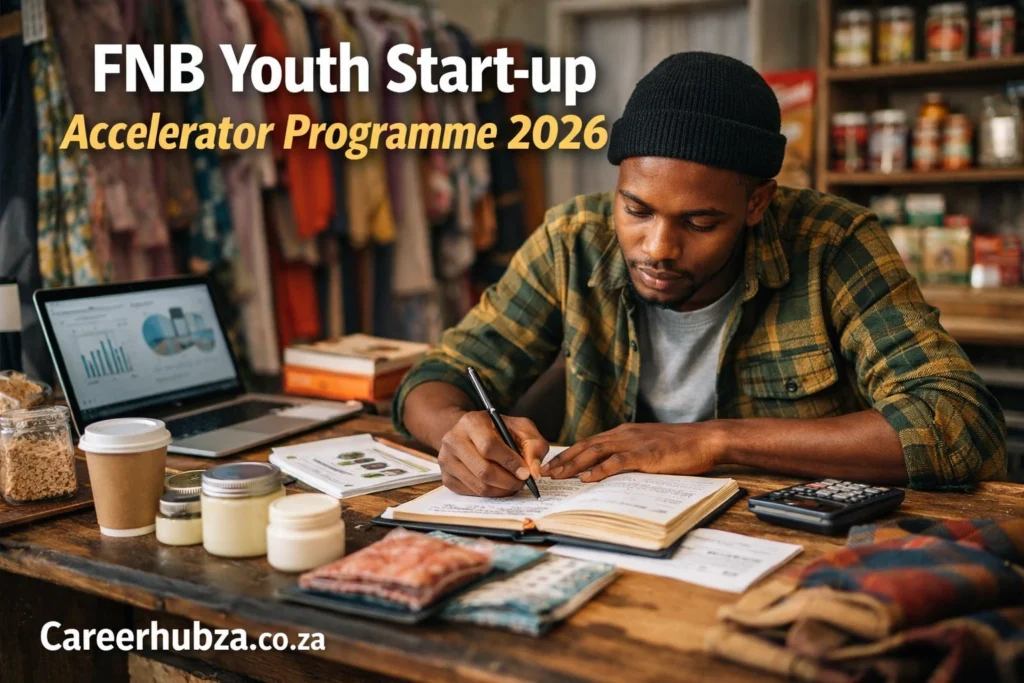
Starting a business in South Africa is not just brave, it’s necessary. With youth unemployment still painfully high, many young people are choosing self-employment not because it’s trendy, but because it’s the only viable option.
The FNB Youth Start-up Accelerator Programme 2026 matters right now because it speaks directly to that reality. It’s designed for young South Africans who already have a business idea, or an early-stage hustle, and need structured support to make it sustainable.
This is not a motivational campaign. It’s a practical intervention.
Why the FNB Youth Start-up Accelerator Programme 2026 Feels Different
South Africa has no shortage of entrepreneurship workshops. What’s missing is continuity, real follow-through that helps founders survive the messy early stages.
The FNB Youth Start-up Accelerator Programme 2026, run in partnership with First National Bank (FNB) and Fetola, is trying to address a specific problem: low sustainability among youth-owned businesses.
Many young entrepreneurs start strong but struggle within the first year. Cash flow dries up. Confidence dips. Isolation creeps in.
This programme doesn’t just offer a once-off workshop. It combines:
- Practical business skills training
- Mentorship (group and one-on-one)
- Peer networks
- Business model testing
- Access to seed capital (depending on phase)
- Market-readiness support
That layered approach suggests a deeper understanding of what early-stage businesses actually need.
Still, it’s competitive. Only 100 entrepreneurs will be selected.
Read more about The AI for Science Master’s Program at AIMS South Africa 2026
Who Should Seriously Consider Applying
Not everyone qualifies, and that’s intentional.
The FNB Youth Start-up Accelerator Programme 2026 is for entrepreneurs aged 18 to 35 who:
- Have an early-stage business or a unique business idea
- Are at least 51% black-owned
- Generate less than R250,000 annual turnover
- Are not studying or employed full-time
- Want to build a profitable business, not an NGO
Preference is given to applicants in township, peri-urban or rural areas. That’s significant. These areas often have high entrepreneurial activity but limited structured support.
Pre-revenue tech platforms and businesses with high capital requirements are excluded. That may disappoint some innovators, but it reflects practical funding limitations. The programme seems tailored toward lean, scalable businesses that can grow with structured support rather than heavy investment.
If you’re still testing your idea casually, this might not be for you. The programme expects full commitment, active participation, and consistent engagement with mentors.
In short: they’re looking for serious builders.
Read more about WeThinkCode VS Umuzi Free Coding Bootcamps
What You’ll Actually Gain (Beyond the Buzzwords)
Entrepreneurship support programmes often promise “growth” without defining it. Here, the offering is more concrete.
Participants receive:
Mindset and mental preparedness support
This may sound soft, but resilience is often what determines survival in the first year of trading.
A business roadmap template
Clarity is underrated. Many small businesses fail because owners operate reactively instead of strategically.
Workshops and webinars
Practical sessions on product development, testing business models, and refining offerings.
Marketing and brand building (Phase Two)
This is crucial. Many township businesses rely purely on word-of-mouth. Structured brand positioning can change revenue trajectories.
Mentorship and peer networks
Perhaps the most powerful element. Being around other founders facing similar challenges reduces isolation and sparks collaboration.
There’s also data support and market-readiness preparation — essential for businesses that want to move beyond survival mode.
However, no programme guarantees success. The impact depends heavily on the entrepreneur’s willingness to apply what they learn. Support can guide you, but execution remains personal.
The Bigger Context: Why This Programme Matters Now
Youth entrepreneurship in South Africa often happens out of necessity rather than opportunity. Many founders are solving local problems with limited capital and little formal training.
Programmes like the FNB Youth Start-up Accelerator Programme 2026 aim to close that gap between hustle and structure.
But there’s another layer.
Corporate-backed initiatives sometimes receive skepticism. People wonder whether they are PR-driven. That concern is fair. However, partnerships with established enterprise development organisations like Fetola suggest this initiative is grounded in implementation rather than marketing.
It’s also important to acknowledge the limitations. One hundred placements cannot solve national unemployment. The scale is small relative to the problem.
Yet for those selected, the impact could be significant.
The applications open on 4 February 2026 and close on 4 March 2026. That’s a short window, and competition will likely be strong.
Before You Apply: Honest Self-Check
Ask yourself:
- Am I prepared to commit fully for the duration of the programme?
- Can I articulate my business model clearly?
- Am I building something that can realistically become profitable?
- Am I ready to be challenged and receive feedback?
If the answer to these questions is yes, this opportunity could accelerate your growth.
If you’re unsure, spend time refining your idea first. Not every opportunity is meant to be rushed.
Apply for the FNB Youth Start-up Accelerator Programme 2026
FAQs About the FNB Youth Start-up Accelerator Programme 2026
Who can apply for the FNB Youth Start-up Accelerator Programme 2026?
South Africans aged 18–35 with an early-stage business or viable business idea that is at least 51% black-owned and earns under R250,000 annually.
Is funding guaranteed?
No. Access to seed capital depends on the phase and readiness of the business. The programme focuses heavily on skills, mentorship, and sustainability.
Can I apply if I’m studying or employed full-time?
No. Applicants must not be studying or employed full-time.
Are tech startups allowed?
Pre-revenue technology platforms are excluded. The focus is on businesses that can realistically grow within the programme’s structure.
How competitive is it?
Very. Only 100 entrepreneurs will be selected nationwide.


